Evolution of the 2025 partnership with ERINHA strengthens the international position of the Orion complex in connecting global capacities for pathogen research that is critical for public health

Legend: In June 2025, CNPEM received the Director-General of ERINHA, the European association coordinating the INTERCEPTOR project (Credits: Outreach/CNPEM)
The Brazilian Center for Research in Energy and Materials (CNPEM) is now part of INTERCEPTOR (INTERnational Cooperation of high containment research infrastructures: from Epidemic Preparedness TO Response), an initiative led by ERINHA (the European Research Infrastructure on Highly Pathogenic Agents) in order to connect global resources for research on pathogens that are critical for public health.
CNPEM’s inclusion as an associate partner is a direct result of the collaboration that began in June 2025, when CNPEM received ERINHA Director-General Dr. Jonathan Ewbank and signed a memorandum of understanding related to Orion, a laboratory complex for advanced pathogen research that will include Latin America’s only maximum biological containment facilities (BSL-4) and the first labs of this kind in the world connected to a synchrotron light source, Sirius, via three beamlines.
Through its incorporation into an international network of high and maximum containment infrastructures, planning for Orion from its very beginning has taken place in dialog with global initiatives, thus favoring scientific cooperation, knowledge sharing and coordinated action in crisis scenarios.
“Advancing these international collaborations is fundamental for Orion, since it allows Brazil to now become part of the main global networks dedicated to research involving high-risk pathogens. By participating in initiatives like INTERCEPTOR, we expand our ability to learn, contribute and act with other countries in a coordinated manner that strengthens not only scientific development but also preparation for health emergencies,” says CNPEM Director General Antonio José Roque da Silva.
As an associated partner, CNPEM will contribute to the project on several different fronts including development of technical and human capacities in high containment laboratories, knowledge exchange between institutions, construction of harmonized protocols, and connections with international entities relevant to epidemic preparedness and response. This participation also involves scientific communication and engagement initiatives, as well as collaboration in mapping and integrating services and skills available on an international scale.
The relationship between CNPEM and ERINHA has been structured around common agendas, especially those related to biosecurity, training human resources and fortifying scientific infrastructures to respond to health emergencies. Participating in INTERCEPTOR extends this collaboration by situating CNPEM within an international network that brings together centers of excellence dedicated to research on high-biological-risk pathogens.
The INTERCEPTOR project is funded by the European Union and brings together high containment research infrastructures in Europe and around the world in order to strengthen international cooperation in epidemic preparedness and response. Coordinated by ERINHA, the project works to integrate scientific, technical and operational capabilities in different countries to promote the harmonization of protocols, team training, resource sharing and construction of a global network of high containment laboratories that can work in a coordinated manner to address emerging health challenges.
Project Orion
Project Orion will be a laboratory complex for advanced pathogen research, and will include Latin America's first maximum biological containment level facilities (BSL-4), the only labs of this kind in the world connected to a synchrotron light source, Sirius. Currently under construction in the city of Campinas, São Paulo on the Brazilian Center for Research in Energy and Materials (CNPEM) campus, this project will combine analytic techniques and advanced competencies in bioimaging which will be open to the scientific community and public agencies. By permitting advances in knowledge on pathogens and related diseases, Orion will support health surveillance activities and policies, as well as the development of diagnostic methods, vaccines, treatments, and epidemiological strategies. Orion will support national sovereignty in facing health crises, and has the potential to benefit various areas such as health, science and technology, defense, and the environment. The implementation of Project Orion is overseen by CNPEM, a social organization linked to the Ministry of Science, Technology and Innovation (MCTI).
About CNPEM
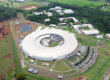
The Brazilian Center for Research in Energy and Materials (CNPEM) is home to a state-of-the-art, multi-user and multidisciplinary scientific environment and works on different fronts within the Brazilian National System for Science, Technology and Innovation. A social organization overseen by the Ministry of Science, Technology and Innovation (MCTI), with the involvement of the Ministry of Education and the Ministry of Health, CNPEM is driven by research that impacts the areas of health, energy, renewable materials, and sustainability. It is responsible for Sirius, the largest assembly of scientific equipment constructed in the country, and is currently constructing Project Orion, a laboratory complex for advanced pathogen research. Highly specialized science and engineering teams, sophisticated infrastructure open to the scientific community, strategic lines of investigation, innovative projects involving the productive sector, and training for researchers and students are the pillars of this institution that is unique in Brazil and able to serve as a bridge between knowledge and innovation. CNPEM's research and development activities are carried out through its four National Laboratories: Synchrotron Light (LNLS), Biosciences (LNBio), Nanotechnology (LNNano), Biorenewables (LNBR), as well as its Technology Unit (DAT) and the Ilum School of Science — an undergraduate program in Science and Technology.