Initiative by CNPEM’s Deputy Directorate of Technology brought together 34 students in projects focused on areas such as magnetic resonance imaging, microfluidics, robotics, automation, and scientific instrumentation
Students from Electrical, Mechanical, Computer and Control, and Automation Engineering presented the results of projects developed throughout the first semester of 2026 at the Brazilian Center for Research in Energy and Materials (CNPEM). The activity, held on June 22, marked the conclusion of another edition of a pilot initiative created by the Deputy Directorate of Technology (DAT), in partnership with PUC-Campinas, to bring university students closer to real technological challenges and contribute to the training of professionals in strategic areas for science and innovation.

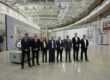
Participants in the program during the final project presentations
The program allows students to participate in the development of solutions related to topics present in DAT’s daily routine, such as automation, mechanical systems, scientific instrumentation, image processing, and equipment development.
“The true value of this program lies in giving undergraduate students the opportunity to immerse themselves in real-world challenges within our technology areas. By working on actual projects, they not only learn concepts and techniques in fields such as mechanical engineering, metrology, vacuum technology, automation, magnetism, and others, but also experience firsthand the complexities of technological development, including technical, administrative, and communication-related challenges. This experience helps prepare the next generation of professionals to contribute to strategic areas for the country.”, says James Citadini, CNPEM’s Deputy Director of Technology.
After a first experience carried out in the second semester of 2025, the initiative reached its second edition, bringing together 34 students from different undergraduate courses, distributed in projects led by 12 DAT advisors. The growth reflects the maturation of the program and the increased student interest in the activities offered by the institution.
The challenges presented to the students covered diverse topics, including the development of floor-marking robots, microfluidic devices, nanomanipulators, unit cells for yeast culture, and mathematical tools for magnetic resonance imaging equipment, among others.
At the beginning of each semester, Deputy Directorate of Technology presents students with a series of technological challenges inspired by activities developed by the institution. Students choose projects of their interest and then start working in teams guided by CNPEM experts. At the end of the period, they present the results obtained in reports and technical seminars.
“Our main objective is to introduce CNPEM to students and show the opportunities that exist here. They often get to know traditional companies to do internships, but they don’t imagine that they can work in a technological research and development environment like this. We want them to have this experience and consider CNPEM when the time comes to choose where to start their professional career”, says Régis Terenzi Neuenschwander, technical advisor at DAT/CNPEM and coordinator of the initiative.
In PUC-Campinas’ assessment, the partnership has contributed to bringing students closer to real technological challenges and a professional environment different from that traditionally found at university.
“The initiative allows students to complement their academic training by participating in real technological challenges and experiencing a highly qualified development environment. Having CNPEM as a partner significantly enhances this experience, offering students the opportunity to learn about technologies, processes, and professionals working at the forefront of innovation. The results presented reinforce the value of this partnership and the growth potential of the initiative”, says professor Sérgio Roberto Pereira, Dean of the Polytechnic School at PUC-Campinas.
A pilot project with expansion potential
In addition to providing students with hands-on experience, the initiative also serves as a learning space for the institution itself. As a pilot project, the initiative has been continuously improved based on the experiences of participants and mentors, who evaluate the proposed challenges and contribute to the enhancement of future editions.
The experience will also serve as a basis for evaluating broader models of technological training. Among the future possibilities is the creation of programs inspired by technological residencies, which combine theoretical training and practical activities in research and development environments. The proposal seeks to broaden the scope of the initiative and contribute to the training of professionals capable of working in highly specialized technological areas.
“The project was born as the first stage of a bigger idea. We are learning alongside the students and building, semester after semester, an increasingly structured experience. The expectation is that this learning can serve as a basis for broader technological training initiatives in the future, inspired by technological residency models that bring students even closer to the scientific and technological challenges developed at CNPEM”, says Régis Terenzi Neuenschwander.
The continuation of the initiative is already scheduled for the second semester of 2026, when a new group of students from PUC-Campinas is expected to participate in the challenges proposed by DAT. The next edition will allow us to consolidate the lessons learned so far and expand the experience built over the first two cohorts.
“We still have a lot to build, but it’s rewarding to see the initiative grow with each edition. The students’ interest and the advisors’ engagement show that we are on the right track to developing something increasingly relevant for talent training and for CNPEM itself”, says Neuenschwander.
About CNPEM
The Brazilian Center for Research in Energy and Materials (CNPEM) is home to a state-of-the-art, multi-user and multidisciplinary scientific environment and works on different fronts within the Brazilian National System for Science, Technology and Innovation. A social organization overseen by the Ministry of Science, Technology and Innovation (MCTI), with the involvement of the Ministry of Education and the Ministry of Health, CNPEM is driven by research that impacts the areas of health, energy, renewable materials, and sustainability. It is responsible for Sirius, the largest assembly of scientific equipment constructed in the country, and is currently constructing Project Orion, a laboratory complex for advanced pathogen research. Highly specialized science and engineering teams, sophisticated infrastructure open to the scientific community, strategic lines of investigation, innovative projects involving the productive sector, and training for researchers and students are the pillars of this institution that is unique in Brazil and able to serve as a bridge between knowledge and innovation. CNPEM's research and development activities are carried out through its four National Laboratories: Synchrotron Light (LNLS), Biosciences (LNBio), Nanotechnology (LNNano), Biorenewables (LNBR), as well as its Technology Unit (DAT) and the Ilum School of Science — an undergraduate program in Science and Technology.