Experimental protocol details challenges and solutions for the study of biocatalysts in beamlines with nanometric beams, such as Carnaúba, at Sirius
A work published in the scientific journal Nature Protocols by researchers from the São Carlos Institute of Chemistry at the University of São Paulo (IQSC-USP) in collaboration with the Brazilian Center for Research in Energy and Materials (CNPEM) presents a detailed guide for the study of biocatalysts under operational conditions, combining X-ray absorption spectroscopy with electrochemical techniques. The article brings together years of experimental development and describes how to study proteins that participate in reactions relevant to various applications, including energy production.
Biocatalysts and green energy
The central motivation of this work is the use of biocatalysts to enable cleaner and more efficient chemical processes. Unlike conventional synthetic catalysts, biocatalysts are three-dimensional, operate under mild conditions, and have high selectivity. This reduces not only the environmental impact, but also operational costs and risks associated with chemical processes.
Furthermore, several of the reactions of interest already occur in biological systems, which allows researchers, instead of recreating complex processes artificially, to take advantage of and adapt mechanisms that have been refined by nature throughout evolution. Another critical point is the use of metals. Industrial catalysts often rely on elements such as platinum or iridium, which are highly efficient but extremely expensive and scarce. Biocatalysts, on the other hand, can offer a more accessible alternative, especially when derived from abundant materials, including plants and fungi.
According to Itamar Neckel, CNPEM researcher at the Carnaúba beamline and co-author of the article, this is one of the main obstacles to the application of these technologies: “It is possible to use platinum and iridium to break down the water molecule and therefore to produce hydrogen, but these elements are expensive.”
In the context of hydrogen production, these characteristics are particularly relevant. Reactions such as water oxidation, which are fundamental to the generation of this fuel, can be mediated by enzymes with specific metal sites, usually of more abundant and cheaper metals, such as copper, for example. Studying these systems is an essential step towards developing more sustainable energy technologies.
XA-SEC: combining X-rays and electrochemistry
To investigate these processes in detail, the study uses an approach known as spectroelectrochemistry, which is the simultaneous performance of electrochemistry experiments with X-ray absorption, or XA-SEC. In practice, this means combining two techniques: applying an electrical stimulus to the material and, at the same time, measuring how the metal inside the enzyme absorbs X-rays.

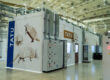
The electrochemical cell installed at the Tarumã station, on the Carnaúba beamline, in Sirius. The combination of electrochemistry and X-rays makes it possible to monitor, in real time, structural and electronic changes in biocatalysts during reactions of interest for the production of sustainable energy.
When an electrical potential is applied, the oxidation state of the metal present in the catalyst can change. These changes directly affect the energy at which the material absorbs X-rays. By monitoring this behavior, researchers are able to monitor, in real time, how the catalyst responds to the reaction conditions, as well as understand the step-by-step process of the reaction.
Each element has a characteristic “absorption edge”, an energy range where a significant variation in photon absorption occurs. Changes in the oxidation state shift this edge, allowing the identification of electronic transformations in the material.
The technique’s distinguishing feature lies precisely in its simultaneity: while different potentials are applied, absorption spectra are also measured. This allows for a direct correlation between electrochemical behavior and changes in the electronic structure of the catalyst, an important window for observing ongoing reactions.
Experimental challenges
Despite the wealth of information, carrying out this type of experiment is far from trivial. One of the first challenges is assembling the electrochemical cell, which requires extremely clean and carefully prepared electrodes.

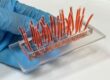
Electrochemical cell used in XAS-SEC experiments. Inside the device, biocatalysts immobilized on an electrode are subjected to different electrical potentials while their electronic properties are investigated by X-ray absorption spectroscopy.
The enzyme of interest needs to be immobilized on the working electrode, usually from a solution that is deposited on the surface. Next, a polymer is added to stabilize the material and allow the passage of cations, preventing the enzyme from dissolving in the aqueous medium or undergoing degradation.
Another critical point is the concentration of the material. Very small amounts make it difficult to detect the X-ray signal emitted by the sample. However, a very high concentration implies an excessively thick layer of enzymes, causing poor electronic connection due to high electrical resistance. Finding this balance requires multiple tests and preparation of several samples until a good region to perform measurements is found.
Besides this, there is the problem of radiation damage. The intensity of the X-ray beam in high-resolution beamlines, such as Carnaúba, can alter the material itself that is being studied, leading to its degradation. Therefore, it is necessary to carry out preliminary tests to ensure that the observed changes are in fact a result of the experiment and not the action of the beam. Adding to this are challenges such as precise alignment of the sample in the experimental station and control of the photon flow, which needs to be optimized to balance signal quality and material preservation.
The importance of experimental protocols
Given the many variables and challenges faced by researchers worldwide, the work developed by these researchers offers a clear systematization of these complex steps in a clear and reproducible protocol. The article brings together not only procedures that worked, but also the problems encountered during experimental development and extensive discussions of the solutions to these problems.
This turns the protocol into a valuable tool for the scientific community. Researchers who wish to work with biocatalysis under similar conditions will now have a guide that anticipates difficulties, suggests solutions, and reduces the time needed to obtain reliable results. As Itamar Neckel highlights, “it will be a very rich reference, because it contains both the measures that were carried out successfully, and also the problems that we faced”.
The protocol also provides guidance on critical steps, such as preliminary characterizations, radiation damage testing, sample preparation, and data acquisition — aspects that, if neglected, could compromise the entire experiment. By consolidating this knowledge, the work facilitates new studies and contributes to the advancement of a strategic area: the development of technologies based on natural processes to face global energy challenges.
About LNLS
The Brazilian Synchrotron Light National Laboratory (LNLS) works with scientific research and technological development that involves synchrotron light, focusing on the operation and utilization of the multidisciplinary potential of Sirius, the country's most advanced scientific infrastructure. With ten research stations already online and open to the scientific and industrial communities, Sirius allows thousands of researchers from various areas to test their hypotheses about the microscopic mechanisms that produce the properties of both natural and synthetic materials which are used in a variety of fields such as health, the environment, energy, and agriculture. LNLS is part of the Brazilian Center for Research in Energy and Materials (CNPEM) in Campinas, São Paulo, a private, non-profit organization overseen by the Ministry of Science, Technology and Innovation (MCTI).
About CNPEM
The Brazilian Center for Research in Energy and Materials (CNPEM) is home to a state-of-the-art, multi-user and multidisciplinary scientific environment and works on different fronts within the Brazilian National System for Science, Technology and Innovation. A social organization overseen by the Ministry of Science, Technology and Innovation (MCTI), with the involvement of the Ministry of Education and the Ministry of Health, CNPEM is driven by research that impacts the areas of health, energy, renewable materials, and sustainability. It is responsible for Sirius, the largest assembly of scientific equipment constructed in the country, and is currently constructing Project Orion, a laboratory complex for advanced pathogen research. Highly specialized science and engineering teams, sophisticated infrastructure open to the scientific community, strategic lines of investigation, innovative projects involving the productive sector, and training for researchers and students are the pillars of this institution that is unique in Brazil and able to serve as a bridge between knowledge and innovation. CNPEM's research and development activities are carried out through its four National Laboratories: Synchrotron Light (LNLS), Biosciences (LNBio), Nanotechnology (LNNano), Biorenewables (LNBR), as well as its Technology Unit (DAT) and the Ilum School of Science — an undergraduate program in Science and Technology.