

Raquel Viana, a student at the Ilum School of Science, was recognized for her research in the field of nanomaterials
Raquel Viana of the Ilum School of Science, the undergraduate degree program at CNPEM (the Brazilian Center for Research in Energy and Materials), received an honorable mention during the 2026 Autumn Meeting of the Brazilian Physical Society (SBF), one of the country’s most important scientific events in this field. The honor recognized Raquel’s early-career scientific work in the field of nanomaterials, conducted under the supervision of professor Valéria Spolon Marangoni.
The twenty-year-old from Cornélio Procopio, Paraná presented a poster on induction of chirality in molybdenum sulfide nanosheets, research that focuses on developing new hybrid platforms with potential applications in areas such as optics and biotechnology. The recognition highlights the quality of research conducted by undergraduate students and reinforces Ilum’s role in training young scientists equipped to work in cutting-edge areas.
During the event, Raquel had the opportunity to present her work to researchers from different institutions, in English, expanding the possibilities for scientific exchange and to refine her research.
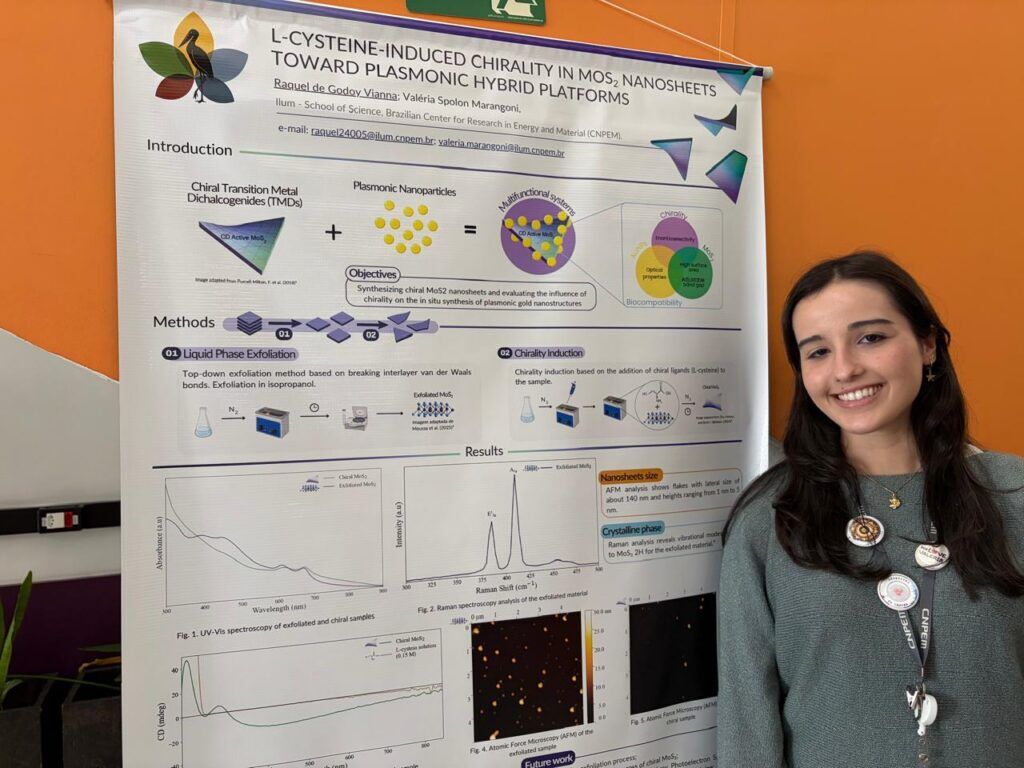
“It was very interesting to be able to interact with different people and receive suggestions on new analyses and ways to expand this project. It was also the first time I presented my work in English, which made the experience even more special. Seeing recognition for research I have been conducting for over a year was very satisfying,” she added.
The award-winning work investigates two-dimensional materials, which can be imagined as structures formed of extremely thin layers. Raquel’s research attempts to isolate these layers and induce controlled torsion in their structure, altering their optical properties and interactions with biological systems. A future goal is to combine these structures with plasmonic nanoparticles to create new materials with unprecedented properties.
For Raquel, the interdisciplinary education offered at Ilum played a fundamental role in her trajectory up to this achievement. The school’s educational model, which integrates physics, chemistry, biology, mathematics and computing from the first semesters, allows students to experience different areas of science and get an early start participating in research projects at CNPEM’s state-of-the-art laboratories.
“Ilum’s interdisciplinary nature makes it possible for us to participate in events in different areas and explore various paths during our undergraduate education. Having this contact with scientific research from the start is very important to discover interests, carry out projects and build a broader view of science,” she said.
Currently in her final year at Ilum, Raquel is already planning to pursue an academic career. After graduation, she intends to enter a graduate program and continue working in the experimental area of nanomaterials, expanding the research she began during her undergraduate career at Ilum.
About the Ilum School of Science
Ilum offers a free undergraduate degree program that utilizes an interdisciplinary approach to train scientists and professionals in science and technology. With an innovative educational model, the three-year full-time bachelor program offers courses that connect life sciences, materials science, data science, artificial intelligence, and the humanities in order to prepare researchers to work in an ethical and collaborative manner in the search for solutions to the global challenges of the twenty-first century. The Ilum School of Science is funded by the Brazilian Ministry of Education (MEC) and is part of the Brazilian Center for Research in Energy and Materials (CNPEM) in Campinas, São Paulo, a social organization overseen by the Ministry of Science, Technology, and Innovation (MCTI). Ilum's educational mission offers early contact with experimental activities, in teaching labs at the school as well as at CNPEM, in projects carried out together with researchers.
About CNPEM
The Brazilian Center for Research in Energy and Materials (CNPEM) is home to a state-of-the-art, multi-user and multidisciplinary scientific environment and works on different fronts within the Brazilian National System for Science, Technology and Innovation. A social organization overseen by the Ministry of Science, Technology and Innovation (MCTI), with the involvement of the Ministry of Education and the Ministry of Health, CNPEM is driven by research that impacts the areas of health, energy, renewable materials, and sustainability. It is responsible for Sirius, the largest assembly of scientific equipment constructed in the country, and is currently constructing Project Orion, a laboratory complex for advanced pathogen research. Highly specialized science and engineering teams, sophisticated infrastructure open to the scientific community, strategic lines of investigation, innovative projects involving the productive sector, and training for researchers and students are the pillars of this institution that is unique in Brazil and able to serve as a bridge between knowledge and innovation. CNPEM's research and development activities are carried out through its four National Laboratories: Synchrotron Light (LNLS), Biosciences (LNBio), Nanotechnology (LNNano), Biorenewables (LNBR), as well as its Technology Unit (DAT) and the Ilum School of Science — an undergraduate program in Science and Technology.

