Registration opens today, February 13, and closes on March 5, 2026.
Registration is now open for another edition of the Training & Capacity Building Program in BSL-3 (Biosafety Level 3) laboratories, offered by the National Research Center for Energy and Materials (CNPEM). Participation is free of charge, and applications remain open until March 5, 2026.
The training will take place from May 11 to 15, 2026. The selection results will be announced by email starting March 17, 2026, and selected candidates must confirm their participation by March 20, 2026.
The program is intended for researchers, undergraduate and graduate students, and professionals from Higher Education and Research Institutions who currently work or plan to work in BSL-3 laboratories. The course aims to promote safe laboratory practices, with a focus on individual and collective protection.
All necessary equipment will be provided by the Program at no cost to participants. However, expenses related to transportation, accommodation, and meals are the responsibility of the selected candidates.
For more information, please visit the Program’s webpage: https://pages.cnpem.br/treinamentonb3/

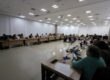
In the photo, a simulation of a training session in BSL-3 laboratories at the training facility located on the CNPEM campus (Credits: Disclosure/CNPEM).
About the Program
Even before the inauguration of the Orion Project — a laboratory complex dedicated to advanced research on pathogens — CNPEM is conducting a Training & Capacity Building Program in high and, very soon, maximum biological containment infrastructures, unprecedented in Brazil. Aimed at developing human resources in competencies that are still limited in Brazil and other Latin American countries, this initiative seeks to support the training of potential future Orion users and to enhance the qualifications of teams already engaged in research and development involving pathogens.
The Program includes theoretical activities and practical sessions carried out in a training laboratory — a mock-up space that faithfully replicates the real facilities of BSL-3 and BSL-4 laboratories. In this simulated environment, researchers in training can practice safety protocols without handling infectious materials or facing any risk of exposure, under the supervision of professionals dedicated to conducting individual assessments of biosafety procedures.
Project Orion
Project Orion will be a laboratory complex for advanced pathogen research, and will include Latin America’s first maximum biological containment level facilities (BSL-4), the only labs of this kind in the world connected to a synchrotron light source, Sirius. Currently under construction in the city of Campinas, São Paulo on the CNPEM campus, this project will combine analytic techniques and advanced competencies in bioimaging which will be open to the scientific community and public agencies. By permitting advances in knowledge on pathogens and related diseases, Orion will support health surveillance activities and policies, as well as the development of diagnostic methods, vaccines, treatments, and epidemiological strategies. Orion will support national sovereignty in facing health crises, and has the potential to benefit various areas such as health, science and technology, defense, and the environment. The implementation of Project Orion is overseen by the Brazilian Center for Research in Energy and Materials (CNPEM), a social organization linked to the Ministry of Science, Technology and Innovation (MCTI). The project is part of the federal government’s New Growth Acceleration Program (PAC) and funded with resources from the National Scientific and Technological Development Fund (FNDCT) and MCTI, with support from the Ministry of Health (MS). This initiative is part of the federal government’s New Industry Brazil (NIB) stimulus policy and will serve as an instrument of national sovereignty, competence, and security in the fields of science and technology for research, defense, and human, animal, and environmental health. Orion was also planned to strengthen the Health Economic-Industrial Complex (CEIS), an initiative coordinated by the Ministry of Health and intended to meet priority demands from the Brazilian Unified Health System (SUS).
About CNPEM
The Brazilian Center for Research in Energy and Materials (CNPEM) is home to a state-of-the-art, multi-user and multidisciplinary scientific environment and works on different fronts within the Brazilian National System for Science, Technology and Innovation. A social organization overseen by the Ministry of Science, Technology and Innovation (MCTI), CNPEM is driven by research that impacts the areas of health, energy, renewable materials, and sustainability. It is responsible for Sirius, the largest assembly of scientific equipment constructed in the country, and is currently constructing Project Orion, a laboratory complex for advanced pathogen research. Highly specialized science and engineering teams, sophisticated infrastructure open to the scientific community, strategic lines of investigation, innovative projects involving the productive sector, and training for researchers and students are the pillars of this institution that is unique in Brazil and able to serve as a bridge between knowledge and innovation. CNPEM’s research and development activities are carried out through its four National Laboratories: Synchrotron Light (LNLS), Biosciences (LNBio), Nanotechnology (LNNano), Biorenewables (LNBR), as well as its Technology Unit (DAT) and the Ilum School of Science — an undergraduate program in Science and Technology supported by the Ministry of Education (MEC).