Researchers will share information locally about how to use the Center’s advanced laboratories and infrastructure
The CNPEM Ambassadors program brought together representatives from teaching and research institutions in northern and northeastern Brazil at the campus of the Brazilian Center for Research in Energy and Materials (CNPEM) in Campinas, São Paulo, on March 20 and 21. The participants were chosen via a selection process prior to the event to act as CNPEM’s ambassadors in their home regions.
They will share their experiences and discuss strategies to raise awareness among colleagues and students at their own institutions about the resources and open scientific facilities that are available to researchers. CNPEM is home to one of the country’s most advanced research structures. The ambassadors also had the chance to visit the Center’s facilities and learn more about the cutting-edge research underway there.

CNPEM offers open scientific infrastructure to the academic community at no charge, providing high-tech equipment, laboratory supplies, and specialized technical support to researchers and students from around the world. The User Program allows scientists from outside the institution to submit research proposals and access the equipment for free. Participants receive financial assistance for travel as well as room and board during the period they carry out their research.
“The initial objective of the Ambassadors Program is to spread information about the different types of aid and access to CNPEM’s facilities in regions that have been less served historically. Our goal is to do this in a structured way, starting by understanding the regional barriers and technical challenges, establishing new communication channels. As outcomes, we hope to have more scientists from these regions coming to our state-of-the-art facilities as we also direct efforts towards supporting scientific topics that are nationally relevant,” said Rosana Tamagawa, Manager of CNPEM’s User Office.
The focus in this first edition is on the North and Northeast of the country, which face more challenges accessing cutting-edge research infrastructure. The ambassadors’ travel expenses were paid by the program. The initiative is supported by COPROPI (the College of Provosts for Research, Graduate Study and Innovation in Federal Higher Education Institutions), which connects the program’s initiatives with university administrations and also helped select the candidates.
The participants highlighted the importance of the program. “Researchers are not yet aware that CNPEM is not just an infrastructure for carrying out experiments on site, but a center that offers complete support, including the ability to send samples and [have] remotely-controlled experiments. Our role as ambassadors is to make this clear and connect this cutting-edge infrastructure with universities and research institutions,” said Gabriel Zazeri, Chair of the Department of Physics and Research Committee President at the Federal University of Roraima.
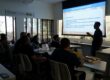
Bruno Sousa Araujo, a physics professor at the Federal University of Ceará (UFC), spoke about his experience at CNPEM, where he conducted research on materials. During a presentation along with other ambassadors who have already used the CNPEM facilities, he explained the techniques he used and the support he received.
“We were reimbursed for our airfare between Fortaleza and Campinas, along with free room and board for two people. We also received constant support from the researchers and technical staff, technical and scientific discussions, and training to use the laboratories,” he added.
Marcele Passos, coordinator of the Biomaterials Laboratory at the Federal University of Pará, stressed the impact of the program in reducing regional imbalances. “We need to publicize that a center with up-to-the-minute infrastructure exists in Brazil and guarantees greater accessibility for researchers from remote regions. The Ambassadors program helps equalize access to science, allowing researchers to conduct innovative studies and contribute to the advance of society.”
She also noted the importance of bringing research closer to the population and reporting on practical applications. “By allowing access to cutting-edge technology, we strengthen academic research and socioeconomic development. The connection between basic and applied science creates innovative products and drives industry.”
About CNPEM
CNPEM is home to a state-of-the-art, multi-user and multidisciplinary scientific environment, with activities within different fronts of the Brazilian National System for Science, Technology and Innovation. A social organization overseen by the Ministry of Science, Technology and Innovation (MCTI), CNPEM is driven by research that impacts the areas of health, energy, renewable materials, and sustainability. It is responsible for Sirius, the largest assembly of scientific equipment constructed in the country, and is currently constructing Project Orion, a laboratory complex for advanced pathogen research.
The Center’s scientific activities are carried out by the Brazilian Synchrotron Light (LNLS), Biosciences (LNBio), Nanotechnology (LNNano), and Biorenewables (LNBR) National Laboratories, as well the Ilum School of Science, which offers a bachelor’s degree program in science and technology with support from the Ministry of Education (MEC).