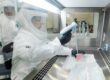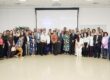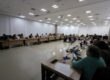
Center introduced Orion’s training programs, scientific infrastructure and advances during the Congress and the Mercosur Virology Meeting, held at UFMG in Belo Horizonte, Minas Gerais

Legend: CNPEM’s stand presented details about the future BSL-4 training lab (the first in Latin America), training initiatives and access to CNPEM’s scientific facilities (Photo: Outreach/CNPEM)
The Brazilian Center for Research in Energy and Materials (CNPEM) participated in the 36th Brazilian Congress of Virology and 20th Mercosur Virology Meeting, held November 20–23, 2025 at the Federal University of Minas Gerais (UFMG) in Belo Horizonte, Minas Gerais. The event was organized by the Brazilian Society for Virology (SBV) and brought together national and international experts to discuss scientific advances, challenges and virology applications in health, the environment and biotechnology.
Throughout the four days of the event, CNPEM had a stand to introduce its main scientific actions and platforms, with information on ways to access the Center’s facilities. The CNPEM team explained to visitors the processes for submitting and analyzing proposals in order to use the platforms available at CNPEM’s national laboratories, which support various lines of research conducted by academic and institutional groups from different regions of Brazil and abroad.
The stand also provided information on the High-Level Biosafety (BSL-3) Lab Training and Qualification Program, which in the future will be extended to maximum-level (BSL-4) labs, an unprecedented initiative in Brazil. The program brings together theoretical components and hands-on activities in the training laboratory on the CNPEM campus, a mock-up space that reproduces operating conditions in a real high or maximum biological containment laboratory.
Another highlight was the presentation of Project Orion, a laboratory complex under construction at CNPEM that will house Latin America’s first BSL-4 laboratory and the first in the world to be connected to a synchrotron light source, Sirius. The Brazilian Society for Virology, which is holding the congress and has already publicly expressed its support for Orion, has CNPEM researcher and virology area head Rafael Elias on its board of directors, reinforcing the alignment between the scientific community in this field and the strategic initiatives carried out by the Center.
Interaction with this specialist audience helps disseminate information about the training, infrastructure and research initiatives that take place at CNPEM, reinforcing the institution’s role in strengthening Brazil’s scientific capacities in areas that are essential for public health and to prepare for emerging challenges in virology.
Project Orion
Project Orion will be a laboratory complex for advanced pathogen research and will include Latin America’s first maximum biological containment level facilities (BSL-4), the only laboratory of its kind in the world connected to a synchrotron light source, Sirius. Currently under construction in the city of Campinas, São Paulo on the CNPEM campus, this project will combine analytic techniques and advanced competencies in bioimaging which will be open to the scientific community and public agencies. By permitting advances in knowledge on pathogens and related diseases, Orion will support health surveillance activities and policies, as well as the development of diagnostic methods, vaccines, treatments, and epidemiological strategies. Orion will support national sovereignty in facing health crises and has the potential to benefit various areas such as health, science and technology, defense, and the environment.
The implementation of Project Orion is overseen by the Brazilian Center for Research in Energy and Materials (CNPEM), a social organization linked to the Ministry of Science, Technology and Innovation (MCTI). The project is part of the federal government’s New Growth Acceleration Program (PAC) and funded with resources from the National Scientific and Technological Development Fund (FNDCT) and MCTI, with support from the Ministry of Health (MS). The New PAC also involves carrying out the second phase of Project Sirius with an investment of approximately R$ 800 million, which will include constructing ten new research stations and optimization of the facilities.
The Orion initiative is part of the federal government’s New Industry Brazil (NIB) stimulus policy and will serve as an instrument of national sovereignty, competence, and security in the fields of science and technology for research, defense, and human, animal, and environmental health. Orion was also planned to strengthen the Health Economic-Industrial Complex (CEIS), an initiative coordinated by the Ministry of Health and intended to meet priority demands from the Brazilian Unified Health System (SUS).
About CNPEM
The Brazilian Center for Research in Energy and Materials (CNPEM) is home to a state-of-the-art, multi-user and multidisciplinary scientific environment and works on different fronts within the Brazilian National System for Science, Technology and Innovation. A social organization overseen by the Ministry of Science, Technology and Innovation (MCTI), CNPEM is driven by research that impacts the areas of health, energy, renewable materials, and sustainability. It is responsible for Sirius, the largest assembly of scientific equipment constructed in the country, and is currently constructing Project Orion, a laboratory complex for advanced pathogen research. Highly specialized science and engineering teams, sophisticated infrastructure open to the scientific community, strategic lines of investigation, innovative projects involving the productive sector, and training for researchers and students are the pillars of this institution that is unique in Brazil and able to serve as a bridge between knowledge and innovation. CNPEM’s research and development activities are carried out through its four National Laboratories: Synchrotron Light (LNLS), Biosciences (LNBio), Nanotechnology (LNNano), Biorenewables (LNBR), as well as its Technology Unit (DAT) and the Ilum School of Science — an undergraduate program in Science and Technology supported by the Ministry of Education (MEC).